
“I thought I would lose my home, my job, and never see my grandkids grow up.”
“Debbie is amazing,” she says. “She’s always positive, encouraging and helpful. With Debbie helping me, I believe that I can do anything.”
“I’ve had counselling before,” she says, “but nothing compares to KAB’s.
“I wouldn’t cope without that support,” Nicky says. “Shopping fills me with anxiety because I can’t read prices or find what I need. Having Julie with me means peace of mind.”
Donate to our Summer Appeal
Our sincere thanks to Tim Newell (whose 3-year old daughter Elodie is being supported by KAB) who has worked closely with Meta to receive a donation of 25 pairs of Meta Ray-Bans to help people we support. We can’t wait for them to be used and see the difference they’ll make.
Meta tells us:
“Our Ray-Ban Meta glasses, through their built-in AI capabilities and partnership with Be My Eyes, are helping people with disabilities navigate their daily lives with greater independence. The glasses enable hands-free calling and texting, real-time speech translation, and visual scene descriptions, while also connecting users with volunteers who can offer personalized assistance. This project embodies our commitment to using technology for good – empowering individuals by providing tools that foster confidence, autonomy, and connection in everyday life.”
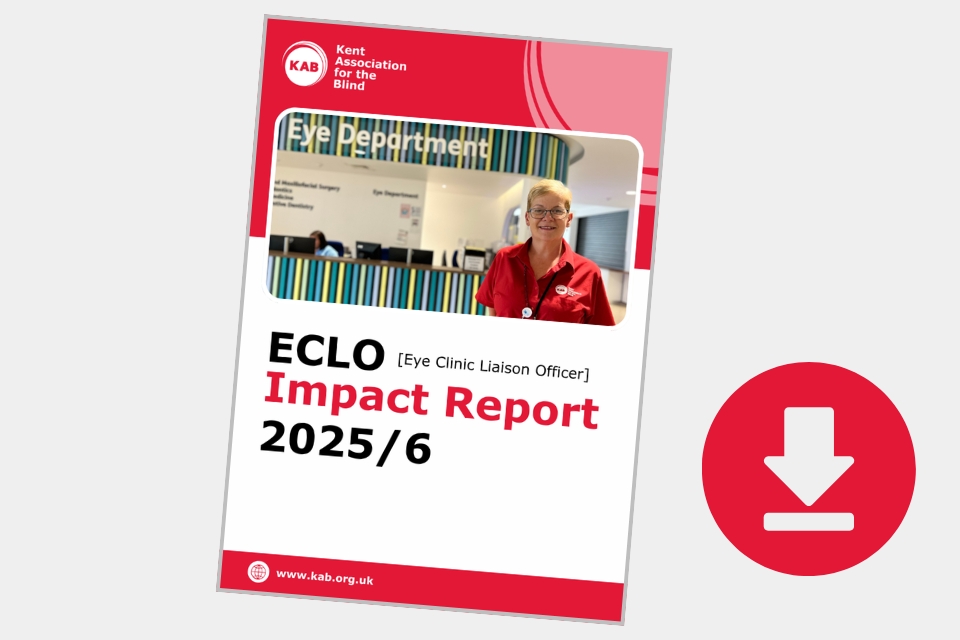
ECLO Impact Report for 2025/2026
Eye Clinic Liaison Officers (ECLOs) are a nationally recognised model of good practice, providing a bridge between Health and Social Care services.
Read about the impact the service has on patients with a sight impairment and to hospital staff.
The ECLO is invaluable to my patients as a link between the clinic and KAB. It is a huge relief to be able to put patients directly in touch with someone who can offer them real help. Patients are invariably grateful for the support.
This Christmas, please help restore hope for someone whose world has been turned upside down.
Last year, everything changed for Richard in an instant.
Richard has Leber Hereditary Optic Neuropathy – a rare genetic disease that can cause sudden and irreversible sight loss. He tells us: “I have relatives who are blind because of the condition, but I never thought it would happen to me.”
One morning, as he was working from home, he noticed a small speck on his glasses. He recalls: “I tried to rub it off, but it wouldn’t. Then I realised…it was really happening to me – I was losing my sight.”
Over just a few short weeks, Richard’s sight rapidly deteriorated. His computer screen magnification went from 200% to 800%. He could no longer read emails or safely cross the road.
I had no central vision. Within two months, I lost my sight. My whole world completely fell to pieces. I truly felt my life was over.
But a friend reached out to Kent Association for the Blind – and that’s when hope began to return.
Richard met Scott, KAB’s Eye Clinic Liaison Officer, at the hospital. “When he reached out, I felt everything was going to be OK. Someone was listening and fighting my corner – chasing doctors and getting me fast-tracked to Moorfields Eye Hospital.”
Next came Hazel, KAB’s Rehabilitation Worker. “She taught me cane training, how and when to cross the road safely, and showed me that life was going to be OK. She helped me learn how to do the everyday tasks I used to do – like using the washing machine, with tactile stickers on the buttons.”
Richard benefitted from KAB’s counselling service when he needed emotional support most, and from our Assistive Technology Team who gave him training to use a computer with specialist software.
I never thought I’d be here today. I don’t know where I’d be if it wasn’t for KAB.
Please help someone like Richard find hope again.
Your gift could help fund the vital services people depend on when their world has turned upside down, like counselling, assistive technology and social groups.
Despite a challenging few years, Richard continues to face life with remarkable determination. With the right support, he’s rebuilding confidence and proving what’s possible – most impressively by completing a tandem skydive this year to raise over £2,000 for KAB. What an achievement!
Make a donation
Support us by donating regularly or a one-time donation.
Rosheen accesses the Guide Communicator service and tells us how this is benefitting her.
When I was just 12 years old, I was diagnosed with Glaucoma and Myopia. Over the years, my vision has gradually deteriorated, leaving me with no sight in my left eye and extreme tunnel vision in my right. Tasks like reading my post became increasingly difficult, and I didn’t want to turn to my Mum or sister all the time.
I knew I needed help, so when I discovered KAB’s Guide Communicator service, I signed up. It’s been one of the best decisions I’ve ever made.
Every two weeks, I meet with my Guide Communicator, Andi, for two hours. The support he provides is invaluable. Today, for example, he’s helping me read my mail. Later, we’ll prepare meals for the week ahead, which allows me to stay independent. Sometimes we go shopping together, which is a real help finding everything I need and identifying expiry dates.
The difference Andi’s support makes in my life is huge. It keeps me more independent and helps me stay on top of everyday tasks without needing to rely on others. The service isn’t just practical – it’s a source of joy too. We laugh together, share stories, and make sure my life continues moving forward, no matter the challenges my sight loss may present.
Get in touch to find out more about the service and the support we provide. This is a paid for service but you may be eligible for financial assistance from your local authority. Get in touch on 01622 691357 (select option 2) or email deafblind@kab.org.uk
Steve is KAB’s Assistive Technology Worker for the West Kent area. Steve shares with us his experience of technology, and how it has helped with his sight impairment, at a recent technology demonstration day.
Here at KAB, as part of my job role, I often attend demonstration days from the companies that kindly lend us equipment for our centres and for Iris Mobile Sight Centre.
Last year, VisionAid came in to demonstrate lots of good tech for our clients, however nothing that would change things for me personally. I have been trying out various magnifiers since primary school, but nothing has really helped my particular sight loss. VisionAid then started to demonstrate the AceSight VR. This is a headset with a built-in camera magnifier.
I decided to have a go myself, as they told me that it could help with things like reading, seeing faces and watching TV. It is similar to a gaming headset but without the sound!
The demonstration of the device made a huge impact…
After a few seconds, I could see a mass of red in front of me. These strange red things were my work colleagues. I then realised that they were waving to me. These are people I see every day, but have never really seen.
The moment was amazing. I don’t often think how much I miss out on by not seeing what people look like, as I am so used to it. But I felt so much closer to everyone now I could see what they look like.
I looked outside and saw cars in detail, normally just a blurry mist. I then read a small business card. Usually I am unable to read very much, just very large letters. However, I could read the smaller text. Reading was still slow, as I have not read text that small for a very long time…if ever.
For me, this is a great device, which I would love to get one day! It is not suitable for everyone; you do require at least a small amount of vision to benefit from it. It doesn’t enable you to suddenly see again! However, the small camera built into the unit may enable you to get the best from your surroundings. I would recommend requesting a demonstration from VisionAid before considering this.
Visit VisionAid’s website: https://www.visionaid.co.uk/acesight-vr
Social groups are our lifeline. They give us confidence and we’ve made life-long friends. Can you support KAB so others can experience this too?
We are Gill, Pat and Chrissy – also known as the Three Amigos! We know first-hand what it feels like to have sight loss. Whilst each of our experiences are very different, we completely agree that having a good network of friends is vital in feeling more confident, connected and less isolated.
We all met over 15 years ago through either a KAB event or social group. Now we often meet up socially and attend the Ashford social group and art group in Canterbury.
For Gill, the groups give her something to look forward to:
“When you lose your sight, you can feel really isolated. Being part of a group means that I have a good reason to get out of the house – it’s great for your mental health.”
Pat loves giving something back. “What I love best is helping others who have sight loss. Chatting to people and making them feel like they are not alone in what they may be experiencing can give them greater confidence.”
Being able to do normal, everyday things means so much to Chrissy. “I’ve learnt how to get to the art groups and exhibitions by train and I feel much more confident and independent as a result.”
KAB’s social groups vary from a catch up in a café to art groups and doing physical activities. Recently we all attended a unique dance workshop, specially designed for sensory needs. We were totally uninhibited and it was the most exhilarating and fun experience.
We get so much out of the groups and we try to give as much back – whether it’s sharing our stories of adapting to sight loss or giving tips on gadgets or equipment that can aid independence. We do this as we know we would appreciate it, if we recently lost our sight.
The true value of a good social group can’t really be measured, but we know that it’s helping us and we hope it’s helping the people we meet there too.
Your support will enable KAB, and their wonderful volunteers, to continue to run 40 social groups; helping over 500 visually impaired people.
If you would like to make a donation to the Christmas Appeal, please visit our donation page: Donate today.
Your donation will make a huge difference, thank you.
At Kent Association for the Blind, we have been supporting people with a sight impairment for 103 years.
During this time, we have been fortunate to have met so many volunteers who kindly give their time to help visually impaired people. One such person is Kathy.
For the past ten years, she’s been befriending Margaret, who has Macular Degeneration. We try to match a befriender with an individual based on personality and shared interests. Fortunately, they have the same sense of humour, so get on really well. They chat on the phone regularly and Kathy visits her once a fortnight.
Margaret enjoys knitting and, between them, they’ve knitted and sent off well over 100 scarves for a disaster-relief charity overseas.
“Kathy is an endless help to me. I don’t know what I’d do without her. She gives me the confidence to do something worthwhile with my time. It helps that she cares and really understands about my eye condition. Kathy is so kind and, whilst we’re working, we talk for a long time about all sorts of things.”
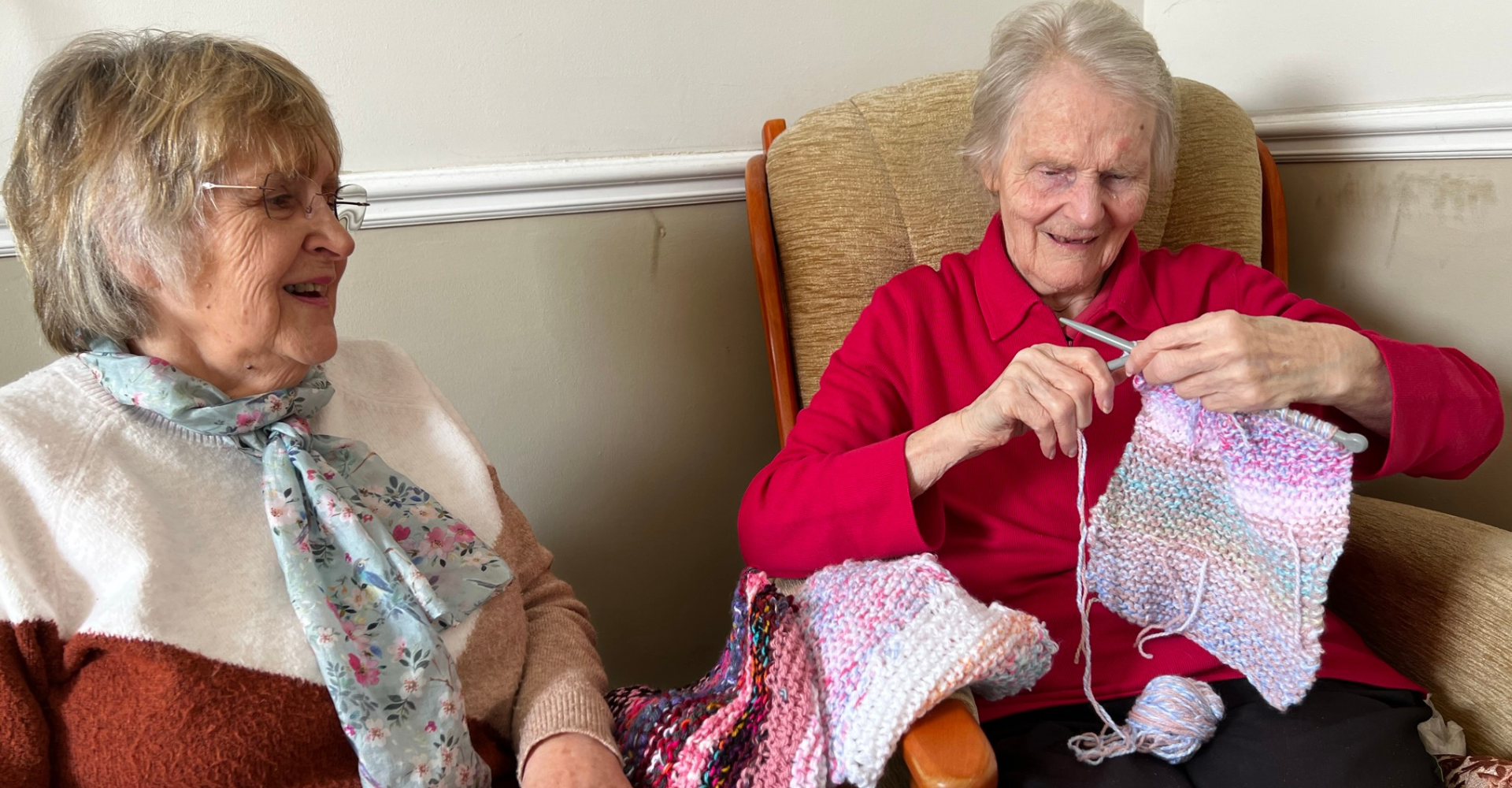
People with a sight impairment are especially vulnerable to loneliness and social isolation. A volunteer befriender is such an important role, helping people to feel less lonely. Kathy decided to become a befriender as she knew the difficulties people with a sight impairment can experience.
“My son is visually impaired and has had support from KAB. I think that if I were visually impaired, I would really appreciate someone visiting me and taking me out. I really enjoy befriending. It is a great thing, for me and for Margaret.”
Margaret lives in a care home. “I don’t do many of the activities here, as my sight is becoming worse. So I really look forward to working with Kathy.”
We currently have over 91 befriending matches and it costs over £52,000 to provide this service; ensuring volunteers are trained and supported.
Can you help us to continue to be there for our clients who are unable to go out or feel isolated? We know it’s a challenging time, but your donation will make a huge difference.
“It looks like it’s going to be a lovely day in Sheppey today…” announces Abbie, whilst co-hosting a show on Sheppey FM; the community radio for the island.
Abbie hadn’t planned on getting into radio, but a family friend used to work at Sheppey FM and suggested she go for an interview. “As soon as I started, I got the bug for it and now I never look back.” Within nine months, she had won a community radio award for her work with the station and she loves coming into the studio.
“I volunteer here once a week and read out the weather, upcoming events and the telephone numbers for any song requests.” Abbie uses her BrailleNote Touch Plus to access the internet to get the weather updates. “I’ve gotten more confident over the years. I used to read out the telephone numbers whilst using my BrailleNote, but now I have them memorised!”
Abbie was really young when she started learning Braille and was fluent by the age of 11. “When I was born, my optic nerves didn’t grow, so I’ve never seen anything. Sometimes I think that’s better than having sight and then losing it. You don’t miss what you have never seen!
I get support from a KAB Guide Communicator (GC) twice a week, who takes me out to various places. It really helps my mental health, as it gets me out of the house. We go to the cinema, shopping, all sorts of places. My GC is great at getting me to be more independent.”
Don’t delay – get your eyes tested!
After waiting until he was 28 to visit the Optician, Ryan is urging people to get their eyes tested once every two years.
Ryan lost his sight in 2018 as a side effect of a brain condition. The damage to the blood vessels at the back of his eyes has led to no vision in his left eye and 40% in his right. “I noticed my eyes were heavy when driving, but I just thought I was tired. My colleague suggested that I go to the Optician to be sure. It was my first ever eye test! We’re recommended to get our eyes tested once every two years. Sadly I didn’t do that. Fortunately the visit has prevented any further damage to my eyes and I’m no longer driving.” Ryan has done a short video, to share his story and promote the benefits of getting regular eye tests.