
When Tony was registered blind in 1999, he did what many people in his position do, he simply got on with life. Diagnosed with Retinitis Pigmentosa and macular scarring, he quietly made adjustments at home and at work, without seeking help. He recalls:
I didn’t want to wear a badge that said I was visually impaired. Even as a lay minister, my congregation had no idea how bad my sight was. I just found other ways to manage.
For years, Tony managed with limited vision; avoiding bright days, relying on taxis, or staying indoors. Then, earlier this year, something shifted.
“I attended a Church of England course where a visually impaired speaker shared his story. As he spoke, I felt like he was describing my life – his experiences, his reluctance to get help, even his decision to try a cane. That planted a seed in my mind.”
That seed took root a few months later. “I couldn’t go outside because of the light. That’s when I realised how isolated I’d become. So I called KAB again.”
What followed, Tony describes as life-changing.
A visit from a KAB staff member introduced him to tools and support he’d never explored. “They gave me overspecs to reduce glare, a liquid level indicator for pouring drinks, talking scales to help manage my diabetes, and the Seeing AI app, which reads text aloud,” he says.
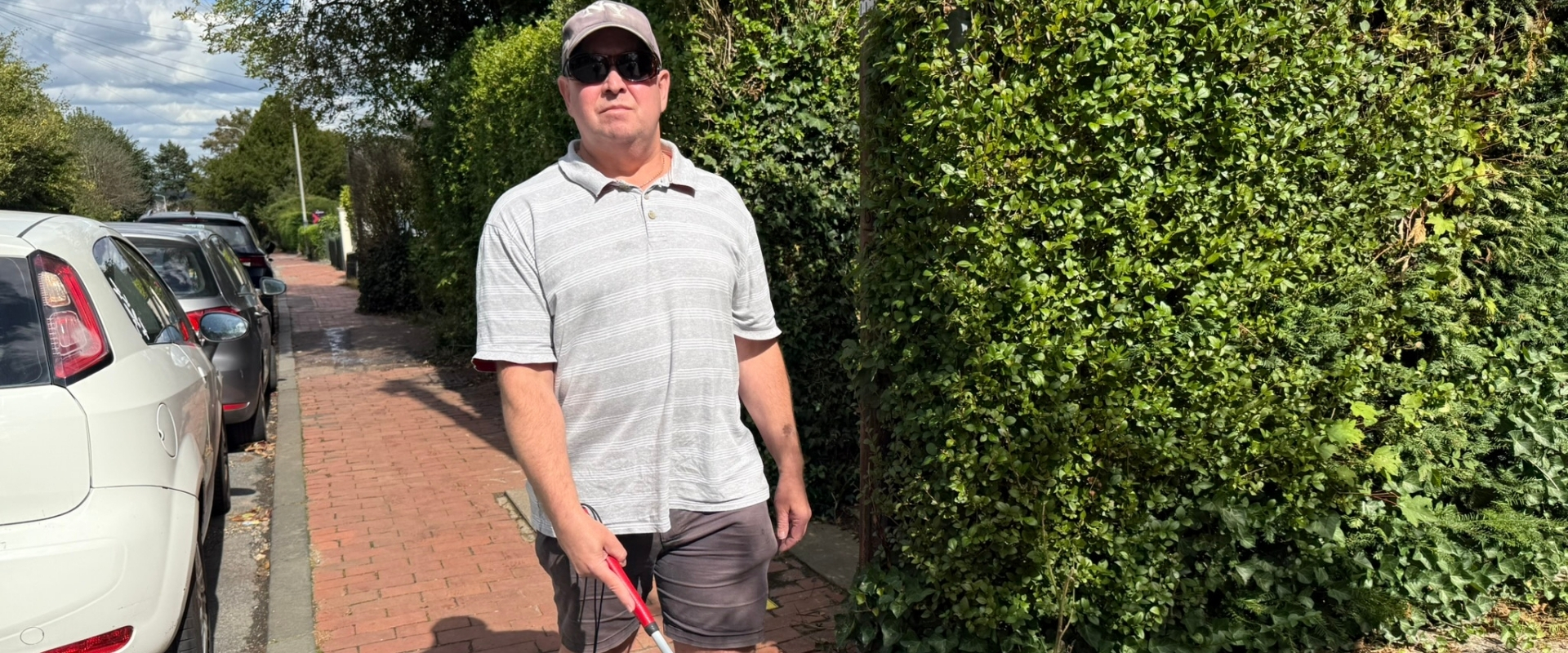
But the real turning point was mobility training. Equipped with a long cane and new skills to navigate safely, Tony now goes out independently.
I learned safer routes into town, how to identify hazards, and how to move with confidence. It’s given me back control of my life.
Now, with the right tools and support, he’s not just more open about his sight loss – he’s embracing life in new ways.
Looking ahead, Tony is filled with hope.
The future starts now. I feel liberated. I don’t have to plan my day around the weather or rely on someone to take me out. There are still challenges, but there are so many more possibilities.
“It looks like it’s going to be a lovely day in Sheppey today…” announces Abbie, whilst co-hosting a show on Sheppey FM; the community radio for the island.
Abbie hadn’t planned on getting into radio, but a family friend used to work at Sheppey FM and suggested she go for an interview. “As soon as I started, I got the bug for it and now I never look back.” Within nine months, she had won a community radio award for her work with the station and she loves coming into the studio.
“I volunteer here once a week and read out the weather, upcoming events and the telephone numbers for any song requests.” Abbie uses her BrailleNote Touch Plus to access the internet to get the weather updates. “I’ve gotten more confident over the years. I used to read out the telephone numbers whilst using my BrailleNote, but now I have them memorised!”
Abbie was really young when she started learning Braille and was fluent by the age of 11. “When I was born, my optic nerves didn’t grow, so I’ve never seen anything. Sometimes I think that’s better than having sight and then losing it. You don’t miss what you have never seen!
I get support from a KAB Guide Communicator (GC) twice a week, who takes me out to various places. It really helps my mental health, as it gets me out of the house. We go to the cinema, shopping, all sorts of places. My GC is great at getting me to be more independent.”